
Featured Site – Historic 625 Building
A Downtown Landmark with a Storied Past
During Keys to Kenosha, visitors will have the chance to explore one of downtown’s most iconic structures: the Historic 625 Building, located at 625 57th Street. This City of Kenosha Landmark is a locally designated historic site with a rich past and striking architecture, making it a must‑see stop during your inaugural Keys to Kenosha experience. Guests can embark on self‑guided tours throughout the building, with brochures available and staff on hand to answer questions as you explore its history and craftsmanship.
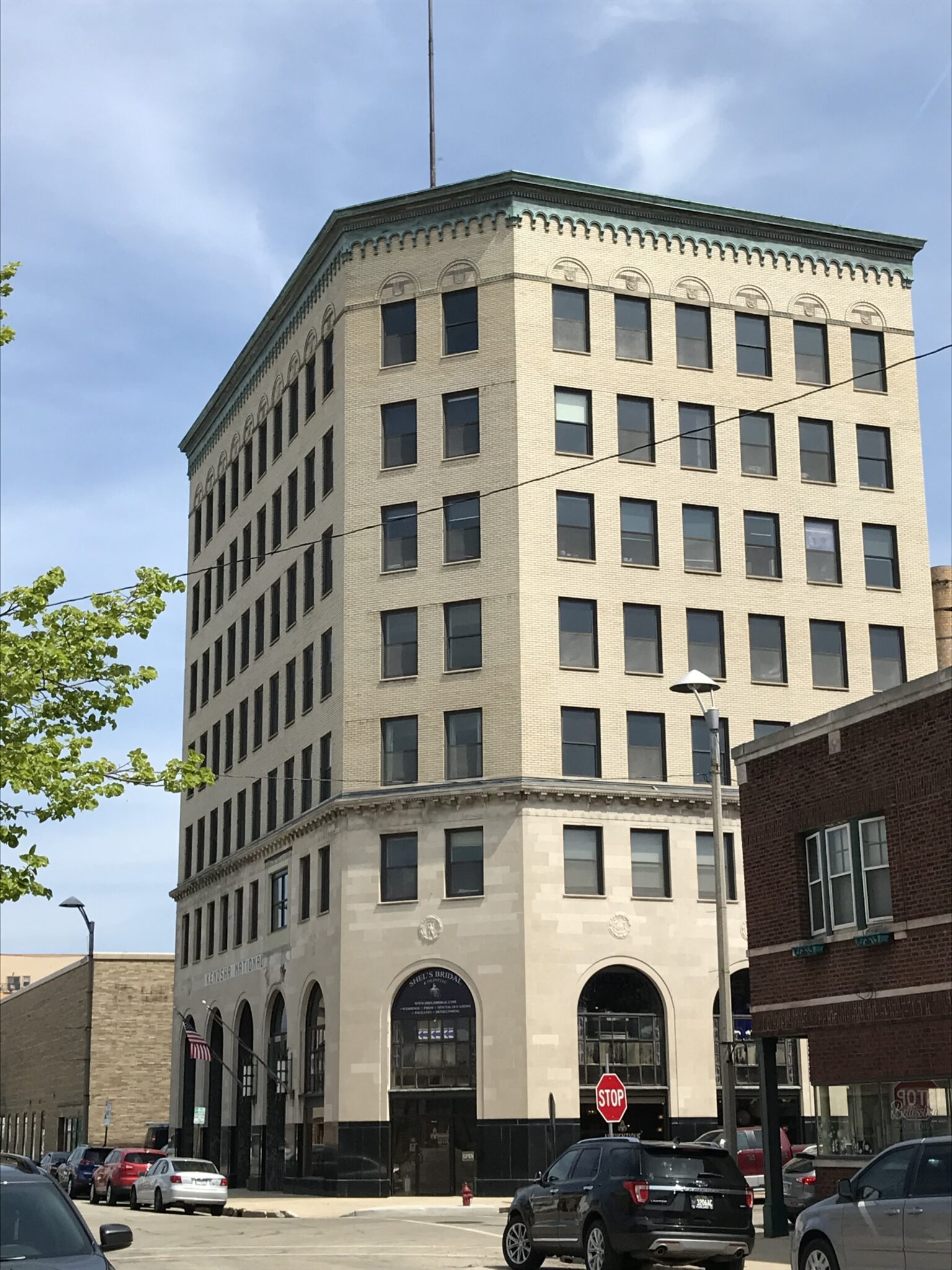
Also known as the Kenosha National Bank Building, the structure was completed in 1928 and quickly became one of the most prominent buildings in the downtown area. With sweeping lake views and vantage points overlooking the entire city center, the building stands as a fine example of streamlined Classical Revival architecture. It is one of only two “skyscrapers” constructed in Kenosha during the late 1920s, a time when local business leaders believed downtown Kenosha was on the verge of becoming a major commercial hub filled with tall, modern buildings. Today, the Historic 625 Building remains remarkably intact, preserving its original architectural details and historic integrity.
A Story of Ambition, Growth, and Reinvention
The building’s history mirrors the dramatic rise and fall of early 20th‑century American banking. It was constructed for the United States National Bank of Kenosha, which began as Citizen’s Bank in 1915. Citizen’s Bank thrived during the booming financial climate of the late 1910s and early 1920s, receiving a federal charter in 1923 and becoming the U.S. National Bank of Kenosha. After merging with another institution, it rivaled the long‑established First National Bank and symbolized Kenosha’s rapid business expansion.
But like many banks of the era, the U.S. National Bank of Kenosha failed in 1932 during the economic collapse of the Great Depression. A new institution, Kenosha National Bank, was formed in 1945 and went on to become a significant financial presence during the post‑World War II era. Through all these transitions, the building remained a steady landmark, witnessing nearly a century of economic change.
Architecture That Defines an Era
Designed by noted architect‑builder Childs and Smith, the Kenosha National Bank Building was constructed during the roaring 1920s, a period marked by optimism, business growth, and architectural ambition. The building originally housed 54 office suites and more than 100 individual offices, with expectations that over 3,000 people would pass through its doors each day.
The Kenosha News dedicated an entire issue to the building upon its opening, celebrating its materials, craftsmanship, and impressive tenant list. The structure was built using Swedish black granite, Indiana Bedford limestone, and buff‑colored Kittanning brick—a stainless brick praised for its ability to “forever keep its cleanliness.”
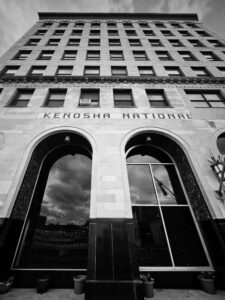
The eight‑story building sits on a corner lot in a distinctive flat‑iron shape, giving it a commanding presence. Its main elevations are crowned with a metal cornice featuring dentils, and beneath it, a metal frieze of arcaded arches and brackets. The top‑story windows are framed by round‑arched reveals filled with brick and accented with rosettes, while a brick belt course runs beneath these arches. A wide stone cornice with modillions highlights the fourth‑story windows.
At street level, massive round‑arched windows define the first two stories, with two of these openings serving as entrances along 57th Street. The main entrance features metal and glass doors flanked by classically decorated light fixtures that add elegance and grandeur.
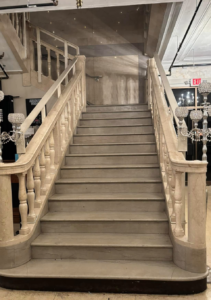
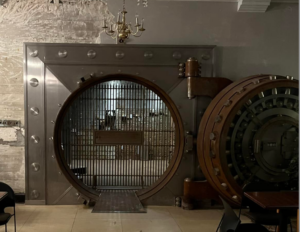
Inside, the building is just as impressive. Walnut flooring and trim, marble sourced from France, Belgium, and Italy, and an ornate horsehair plaster ceiling—designed specifically for the bank by famed Italian artist Antony Dilorenzo—create an atmosphere of sophistication. The ceiling remains one of the building’s most breathtaking features. A graceful staircase leads to the lower level, where a large walk‑in vault houses more than 5,500 safe deposit boxes. Built with over 300,000 pounds of concrete and steel, the vault includes a 24‑ton swinging stainless‑steel door that stands as a marvel of engineering.

A Landmark Ready to Be Explored
The Historic 625 Building is filled with stories, architectural treasures, and reminders of Kenosha’s past. During Keys to Kenosha, visitors will have the chance to explore this remarkable structure, learn about its history, and appreciate the craftsmanship that has kept it standing strong for nearly a century. With its beautiful architecture, sweeping views, and deep roots in Kenosha’s commercial history, the Historic 625 Building is a site you won’t want to miss.